Look, narrow, confirm
Nobody names a tree from one glance. You gather what you can see, let each clue rule trees out, and check the last few against a book for where you live.
Look
Leaf or needle, how it sits on the twig, the bark, any fruit or cones.
Narrow
The key asks one question at a time and ends at a group, such as oaks or spruces.
Confirm
Each group page says what to check next, and a regional field guide names the species.
What tree is this?
Start from a leaf, the bark, a fruit or a bare twig. Every step shows what to look for, and the key ends at a group of trees and a page to confirm it.
Answer each question and follow the matching branch.
What do you have in front of you?
- Leaves or needles
What are the leaves like?
- Needles
How are the needles attached?
- In bundles, wrapped at the base
How many needles are in one bundle?
- Five → Eastern white pine
- Three → Three-needle pines
- Two → Two-needle pines
- In tufts on short, knobby spurs
In winter, does the tree keep its needles?
- No, they turn yellow and drop → Larch
- Yes, it stays green → True cedars (Cedrus)
- Singly, all around the twig
Roll a needle between your fingers. What is it like?
- Stiff, sharp and square, so it rolls → Spruce
- Sharp, three at a point, with a white stripe → Juniper
- Flat and soft
What do the flat needles and cones look like?
- Cones stand upright; needles blunt with a round base → True fir
- Cones hang down with three-pointed tongues between the scales → Douglas-fir
- Short needles on tiny stalks; very small cones → Hemlock
- A red fleshy cup instead of a cone → Yew
- In bundles, wrapped at the base
- Tiny overlapping scales → Cedars, junipers and other cypress-family trees
- Broad, flat leaves
Is each leaf one piece, or split into leaflets?
- One piece (simple)
Are the leaves in pairs or staggered?
- Opposite: in pairs
What is the leaf shaped like?
- Lobed, with several main veins from the base
Look at the lobes, the twigs and the underside.
- Smooth, rounded gaps between lobes; few teeth → Sugar maple
- Toothed lobes, red twigs or buds → Red maple
- Deeply cut, silvery white beneath → Silver maple
- Milky sap from a broken leaf stalk → Norway maple
- Plain edge, curved veins → Probably a dogwood
- Lobed, with several main veins from the base
- Alternate: one at a time
What is the shape and edge of the leaf?
- Lobed, with rounded or bristle-tipped lobes
Look at the tips of the lobes.
- Rounded, with no bristles → White oak group
- Pointed, each tip ending in a fine bristle → Red oak group
- Leathery, evergreen and unlobed → Live oak
- Lopsided base, double-toothed edge → Elm
- Round on a flattened stalk → Aspen and cottonwood
- Oval, double-toothed, with peeling bark → Birch
- Star-shaped, like a maple but staggered → Sweetgum or sycamore
- Four lobes with a square-cut tip → Tulip tree
- Mitten-shaped, unlobed or three-lobed → Sassafras
- Heart-shaped → Redbud or basswood
- Oval and toothed, with smooth grey bark or glossy leaves → Beech, cherry or apple
- None of these → Not covered by the key yet
- Lobed, with rounded or bristle-tipped lobes
- Opposite: in pairs
- Split into leaflets (compound)
Are the leaves in pairs or staggered?
- Opposite: in pairs
How do the leaflets sit?
- Along a central stalk, like a feather → Ash, or boxelder
- Spreading from one point, like fingers → Horse chestnut and buckeye
- Alternate: one at a time
What else can you see?
- A nut in a green or brown husk
Slice a twig lengthwise. What is the pith like?
- Thorns at the leaf base, hanging white flowers or flat pods → Black locust
- A nut in a green or brown husk
- Opposite: in pairs
- One piece (simple)
- Huge fronds on an unbranched trunk → Palms
- Needles
- Bark
What is the bark like at chest height?
- Smooth → Trees with smooth bark
- Ridged or furrowed → Trees with ridged bark
- Scaly or in plates → Trees with scaly or plated bark
- Peeling in papery layers → Trees with peeling bark
- Shaggy or stringy → Trees with shaggy bark
- Fruit, seeds or cones
What kind of fruit, seed or cone is it?
- Acorn: a nut in a cap → Oaks
- Two winged seeds joined together → Maples
- A single winged seed, or a flat round wing → Ash and elm
- A hard nut in a husk → Nuts
- A woody cone → Conifer cones
- A fleshy fruit with one stone → Drupes
- A blue berry-like cone → Juniper
- A flat pod like a bean → Pods
- A fleshy apple-like fruit with a core → Apple
- A ball, catkin or small seeds on a stalk → Balls, catkins and clusters
- A bare winter twig
Are the buds in pairs or staggered?
- In pairs, facing each other → Opposite-bud trees
- Staggered, one at a time
Look closer. What stands out?
- Buds clustered at the tip of the twig → Oak
- Long, slender, pointed buds on smooth grey bark → Beech
- The pith has chambers when sliced → Walnut
- Something else → Use the picker
Every way of reading a tree
The guide
- LeavesSimple or compound, opposite or alternate, edge and shape
- Leaf shapesA picture guide to leaf outlines, edges and arrangement
- Needles and conesBundles, single needles, scales, and what the cones do
- BarkSmooth, ridged, scaly, peeling, shaggy
- Bark textureRidges, plates, scales, strips and peels, with examples
- Bark colourPale, dark, red-brown and mottled, and why colour is unreliable
- How bark changes with ageFrom smooth sapling bark to the ridges of an old tree
- Fruit, seeds and flowersAcorns, samaras, nuts, drupes and catkins
- Buds and twigsWinter identification from a bare branch
- Shape and sizeCrown outline, trunk and where the tree grows
- PalmsFan or feather fronds on an unbranched trunk
- Young trees and saplingsWhen there is no bark or fruit to go on
- ShrubsTelling a shrub from a small tree, and naming one by its leaf
- Fruit treesApple, pear, cherry, plum and peach: blossom, leaf and fruit
Seventeen groups of common trees
By tree
- OakAcorns, and leaves that are usually lobed
- MapleOpposite leaves and paired winged seeds
- BoxelderA maple with compound leaves
- ElmLopsided leaf base and double-toothed edge
- AshOpposite compound leaves and single-winged seeds
- HickoryAlternate compound leaves, solid pith and nuts in a husk
- WalnutAlternate compound leaves, chambered pith and round green husks
- BirchPale peeling bark, double-toothed leaves and catkins
- Aspen and cottonwoodTrembling leaves on flat stalks, and pale bark
- PineNeedles in bundles of two to five
- SpruceSingle, stiff, four-sided needles on woody pegs
- Fir, hemlock and yewFlat single needles, and cones that stand or hang
- Douglas-firNot a fir: hanging cones with three-pointed bracts
- LarchNeedles in tufts, and a conifer that drops them
- Cedars and junipersScale leaves, and a word used for many trees
- JuniperSharp needles or scales, and blue berry-like cones
- Other common broadleaf treesTulip tree, sweetgum, sycamore, cherry, dogwood, redbud, locust, beech and more
About trees
Background
- DendrologyThe study of trees, and how they are named
- What is a tree?Wood, height, a single trunk, and where the definition gets fuzzy
- The evolution of treesFrom the first forests to oaks and pines
- Why different trees grow in different placesClimate, soil and the shape of the land
- Why leaves are the shape they areLight, water, wind and what the shape does for the tree
- The benefits of treesShade, water, air, habitat and why they are worth knowing
- Identifying tree health problemsWhat damage looks like, and who to ask
- Endangered trees in AmericaTrees that disease, pests and climate have pushed to the brink
- Christmas treesTelling the firs, spruces and pines on the lot apart
- A kids' guide to tree identificationFour easy games to learn trees, for children and the grown-ups with them
Careful, and checked against real sources
Every description here is written from standard botanical references, such as the USDA PLANTS Database, the Forest Service's Silvics of North America and the Woodland Trust. Sources are linked at the foot of each page.
How the guide works
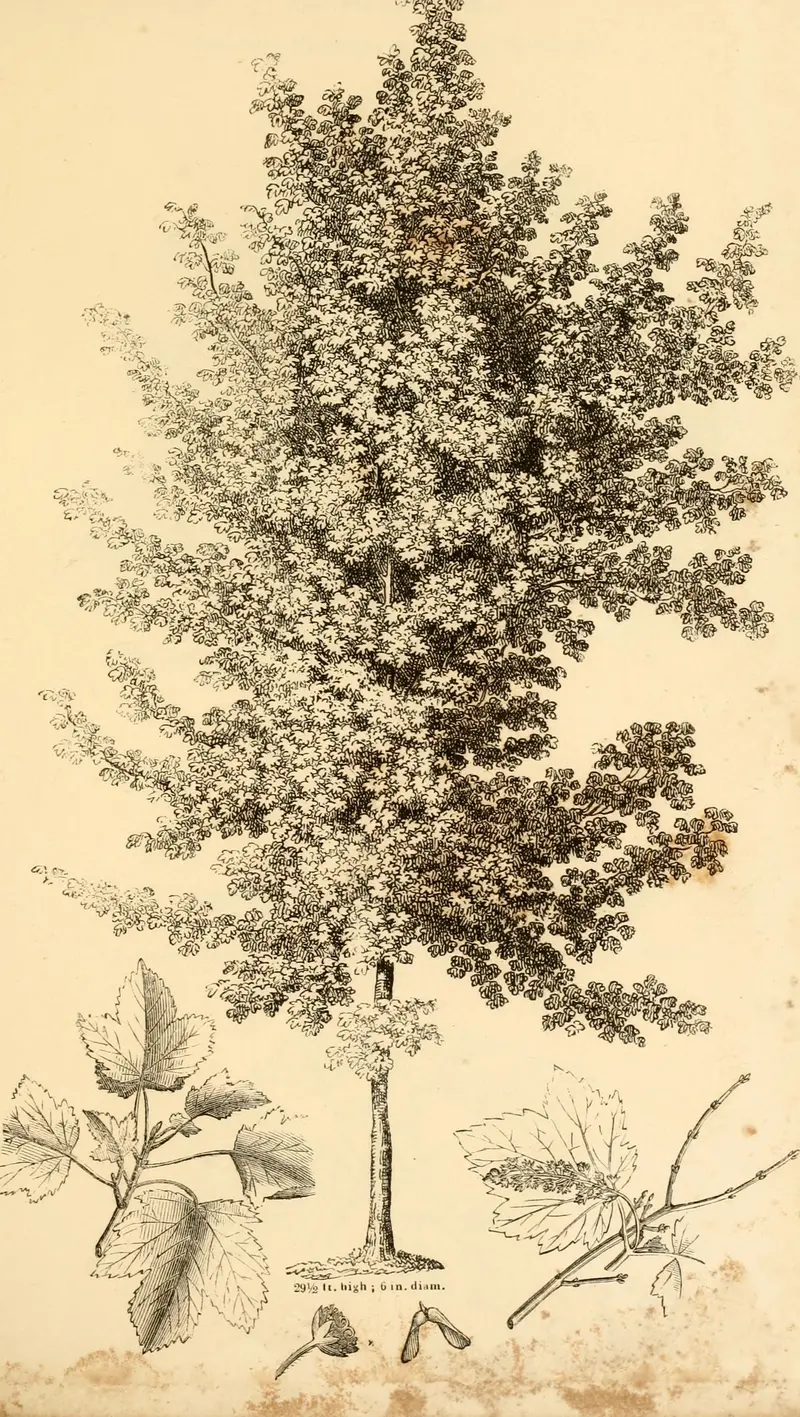
Turkey oak, from J. C. Loudon, Arboretum et Fruticetum Britannicum (1844). Public domain, via Wikimedia Commons.
- Tree groups
- 17
- Trees profiled
- 52
- Ways to look
- 14
- Terms defined
- 38